Afloat
“[An] exemplary new work of creative history”,
The Scotsman
Published 23.4.26

Buy Afloat here (Hive.co,uk).
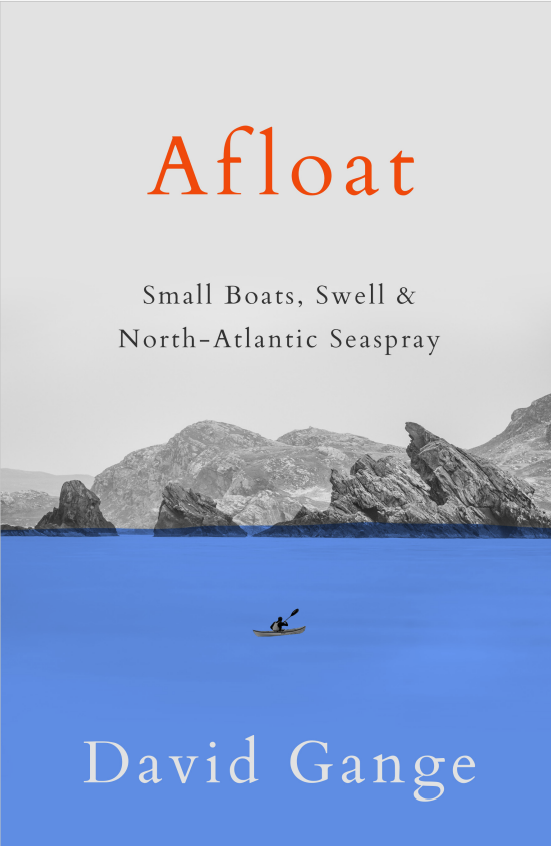
Small traditional boats fulfil roles in their communities unlike any other supposedly inanimate things. Often treated as living members of the family, with minds and lives of their own, they’ve been essential to many cultures’ ways of living in the land- and sea-scapes round them. Intimately adapted to specific bays and headlands, tides and prevailing winds, they bind people and place together. Wherever we have statistics, small rowed and paddled boats outnumber decked ships by at least fifty to one. Yet almost all history writing is about the big boats, because their involvement in formal markets means they left documents behind. This amounts to a strange misrepresentation at the heart of maritime history, which tends to focus on the port town, not the rural family boat noost or spruce-root picking forest, and on metropolitan powers, not the oral cultures of the shore.
Afloat is the story of eight journeys in search of ocean-going rowed and paddled boats. It involves thousands of miles of kayaking, hundreds of miles in wooden, canvas, and birch-bark boats, dozens of nights sleeping at the shoreline, and weeks in boat builders’ workshops learning, with saw or plane in hand, the songs and stories of these charismatic vessels. It involves taking part in community pilgrimages to tiny islands on their saint’s days, and in races and regattas that express revivals of commitment to local boats and the community ideals they sustained. Along the way there are encounters with whales, dolphins, sharks, turtles and icebergs, as well as journeys beneath skies filled, from horizon to horizon, with tens of thousands of seabirds. Most of all, though, these journeys involve learning from the worldviews of small communities who have suffered intensely from the nation- and empire-building of modern states, but whose knowledge and ethics are far more important for the future than those of the inland bureaucracies that marginalised them.


Reviews
The Scotsman:
“We stand at a moment of unprecedented creativity among historians,” writes David Gange in Afloat, his exemplary new work of creative history…For Gange, a historian at the University of Birmingham specialising in small rowed or paddled boats, creative history inevitably means getting wet. “To comprehend the worlds I feel urgently compelled to learn about,” he writes, “I need to immerse myself in swirling air and ocean, surround myself with past people’s workplaces on cliff edge and skerry, and travel the sea routes past families traversed.” For most historians writing in this area, a token day or two at sea might suffice. Gange, however, is not most historians.
…It’s difficult, in the scope of a review, to do justice to the magnitude of some of the adventures he describes…Even more impressive than his physical achievements, though, is the way he makes the case for the virtues of small, boat-based communities – poor inconventional Western terms, perhaps, but incredibly rich by other, arguably more meaningful measures. We would do well to…learn from them and attempt to apply a little of their wisdom”.
The Irish Times:
“An intimately observed study of life at sea, in all its adaptation. Gange is brilliant on the innovations coastal communities make to navigate headlands, tides and rocks, each vessel an instrument in the endless play of wood and rope, hide and tar. He gathers these places in a windblown fugue [and] takes to the water with a keen ear for the sea’s speech. His journeys are also studies of birds, seals, whales and the people who live with them in cultures that are as rich as the environments they inhabit. The result is an immersive, thoughtful book”.
James Macdonald Lockhart:
“A love letter to the coastal communities of the North Atlantic. Gange’s travels through these places are spellbinding to read, the depth of his historical research is so commendable. I found myself both absorbed and moved by this quest to find beauty and wonder in the culture and craftsmanship of these boats”.
Country Life Magazine:
“Exploring history from the level of a small boat, he offers not only a thrilling adventure to the remotest shores, but a new perspective, which, he hopes, 'can allow us to see our world anew and imagine ways to make it better'.”
The Spectator:
“In his study of the cultural history of small boats, [Gange argues they are] transports of delight and a key component in the survival of precious maritime communities.”
Moya Cannon:
“David Gange brings us on a marvellous voyage, not of conquest, but of restoration. He kayaks between ice floes, rows us up fjords, traces coastlines in an arc from Galway north to Greenland and then south to the Barbados, introducing us to the small boats of the northern Atlantic and the communities which depend upon them. In prose that is precise and beautiful as northern light, he shares with us the aesthetic thrill of experiencing an indigenous boat in the environment which has shaped it over time. This book is an absolute delight'
Isle of Man Today:
“A beautifully bouyant read…about as far from the image of a dry academic as you can get. An award winning photographer and lyrical writer with a fascination for all vessels small”.
Alistair Moffat:
“A beautifully written and beautifully made book. David Gange's rowed and paddled journeys in small boats are full of drama, insight and revelation”.


Contents
Preface: The World in the Wave
Introduction: The Lives & Love of Little Boats
Conamara/Connemara: In Search of the Donkey Boat
Leòdhas/Lewis: The Shores Boats are Built From
Interlude: Of Clinker, Carvel, Birchbark, and Sealskin
Sápmi: A Pine Tree at Sea
Føroyar/The Faroes: Down Comes the Puffin from the Cliff
Interlude: Crossings & Connections
Kalaallit Nunaat/Greenland: Home Is Where the Umiaq Is
Ktaqmkuk/Newfoundland: London Is a Ladder up the Cliffs
Maine and Massachusetts: Forest Seas
Barbados: Sea Flower, Sea Moss, Moses Boats
Epilogue: To Understand What’s Beautiful


Preface: the World in the Wave

I
Landing in the Past
There’s a moment when, riding a heavy swell, you make the choice to turn the nose of your little boat to shore and let the breakers tower above you as you ride their raging forms towards a beach. If this has been a long journey, and this is a shoreline you don’t know, there’s fear in the possibility of a black rock reef or other unseen danger amid the swirling foam. But once the breakers grip you, there’s no hope of stopping and little chance to turn.
It's the point just before committing to that chaos that’s most memorable. One moment the swell lifts and drops you dramatically but gently. It carries you up and down twenty feet in the space of seconds while you guide your bow along a low-risk line. Suddenly, though, you’re staring at the backs of rows of water that are angry and angular. They appear willful and alive in the strange shapes they seem to choose to take. What was slow, inky swell now runs white and turquoise and is violently, frantically, loud in all directions.
There’s a moment, looking at the back of the towering breakers, but before the white water hammers down on you, when you imagine what it will feel like to be in their midst. You experience a stunningly vivid empathy with a version of yourself who is just two short seconds in the future but who still feels an infinity away. That moment of visceral imagining is both accelerated and slowed, both full of joy and fear. It involves committing yourself completely to a drastic risk, taken in faith that perfect safety lies just beyond the bruising clatter into sand.
This moment always lodges itself in memory in ways unlike anything else. It returns in dreams. It flashes suddenly into focus when waiting in a queue or immersed in office admin. What I love most about the way this sublime split-second echoes through memory is that it means that once you’ve had the ocean roar around you, it will never truly let go. It feels like you’re, paradoxically, scarred by joy. You return to everyday life a little wilder: you’re emotionally slightly unmoored, and psychologically salt-rimed. I spoke, in the course of this project, to people in care homes and on dementia wards, for whom memories of steering sea squalls long ago are keys that unlock their clear-eyed younger selves and inspire a kind of elemental eloquence.
These moments that twist time and skew perspectives do so in multilayered ways: they can seem to carry you beyond the present completely, evoking fellow feeling with those countless others whose daily lives have involved confrontation with ocean. The voices you hear on the wind might be men in sealskins or tweeds shouldering oars or paddles, or women in thick woolens, wading waist deep in sea to drag the boats ashore. They’re voices joined in the chanted rhythms that happen wherever a community comes together to haul its heavy boats. That your moment in the wave could be situated at any specific time between deep past and present seems as improbable as dry feet in a sea storm: nothing could make me feel more like a fragment out of time, or more like I was renewing a timeless dance of people, boats, and sea.
To be a historian is to seek out the meanings of experiences like these: to observe their fabric and pull at its threads, unravelling any knowledge they might reveal. This book’s journeys among small traditional boats on North Atlantic seas, like its conversations with boatbuilders and seafarers, and its many nights spent on elemental shorelines, are attempts to attune empathy with past people of the coasts. To recount their boatish stories and songs is to build a portrait of distinctive ways of life and modes of thought. To try to think with their sea knowledge, and see the world as if through their eyes, is the way to survive in a small boat at sea. But I hope to show across the pages of this book that the diverse worldviews possessed by these cultures of small boats also provide possibilities for living that can help our floundering societies stay afloat.